Penetration sealing
Every pipe, cable and duct that passes through a fire wall needs its own tested seal.
Get a priceA penetration is anything that passes through a fire wall or floor. A pipe, a cable, a tray full of cables, a duct, a conduit.
When it goes in, the wall gets a hole. If nobody closes that hole properly, fire and smoke use it as a door.
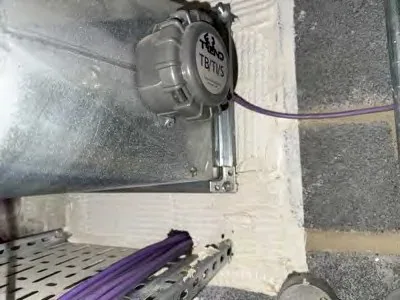
Matching the seal to the hole
No single product seals everything. The seal has to suit the thing going through and the wall or floor it goes through.
A steel pipe through blockwork needs one thing. A plastic pipe through a plasterboard wall needs another. Cable bundles change over time as people add to them, so those get a third.
The seal also has to match the rating of the wall, which is normally 30, 60 or 120 minutes. A 60-minute wall with a 30-minute seal is a 30-minute wall.
What goes in
Coated mineral wool batts for larger openings, fitted tight round trays and ducts. The coating swells in heat and closes any remaining gap.
Intumescent mastic to finish the edges and seal small gaps. See the page on intumescent mastic.
Collars and wraps where a plastic pipe passes through. See fire collars and wraps.
Pillows in openings that need to be reopened later, such as a riser where cabling changes often.
Our BM TRADA / FIRAS-certificated contractors choose each one from the maker's tested details. They do not mix and match.
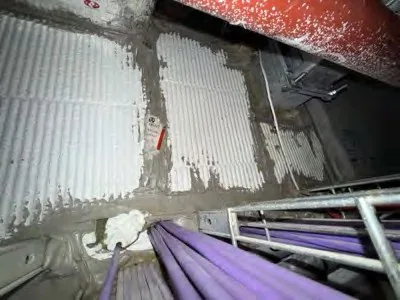
Cables are the awkward one
Cable trays grow. A tray that was half full when the seal went in is full a year later, and someone has threaded another run through the middle of the seal.
If you know more cables are coming, say so. We can fit a seal that can be opened and closed again by someone who has been shown how, rather than one that gets cut out every time.
Labels
Every seal we fit gets a label. It says what the seal is, who fitted it and when.
Without a label, nobody can tell a good seal from a bad one by looking. With one, an assessor or an insurer can see straight away.
Where we start
With the survey or the fire risk assessment, if you have one. Otherwise we survey first, because quoting for holes nobody has counted is guesswork.
Questions we get asked
Can I reseal a hole myself with foam from a DIY shop?
Not for a fire wall. Ordinary foam is not tested as a fire seal. See expanding foam and fire stopping.
What if the wall rating is unknown?
We check the plans and the drawings you hold, or look at how the wall is built. If we still cannot tell, we ask your fire risk assessor to confirm it before we seal anything.
Will you leave the area tidy?
Yes. We clear up before we leave.
Send us the postcode and a photo or two. We will tell you what it needs and give you a price.
Get a price