Fire collars and wraps
A plastic pipe burns away in a fire and leaves an open hole. A collar closes it.
Get a pricePlastic pipes are everywhere in modern buildings. Waste stacks, soil pipes, water supply, condensate lines from boilers and air handling.
In a fire, the plastic softens and burns. A pipe that was blocking a hole one minute is the hole the next.
That is what a collar is for.
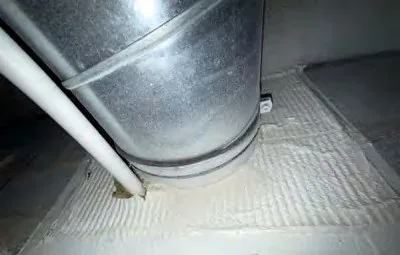
How a collar works
A collar is a metal band lined with a material that swells when it gets hot. It is fixed round the pipe at the point where the pipe goes through the wall or under the floor.
When a fire heats it, the lining expands inward and squeezes the softening pipe shut. The hole closes before the flames get through.
A wrap does the same job in a different shape. It is a strip of the same swelling material that goes round the pipe in several turns, and it suits places where a rigid collar will not fit.
Where they go
Under a floor slab, where waste pipes come down through the ceiling of the flat below.
At the face of a wall, where a pipe goes through from one room to the next.
In a riser, where several pipes run up through a series of floors.
For a pipe going through a floor, the collar goes on the underside of the slab. On a wall, the manufacturer may say one on each face. Our contractors follow the tested instructions for the product, not a rule of thumb.
What decides the collar
The pipe material. PVC, polypropylene, ABS and polyethylene all behave differently.
The pipe diameter. A 110mm soil pipe needs a bigger collar than a 32mm waste.
The wall or floor it goes through. Concrete, blockwork and plasterboard are fixed in different ways.
The rating the wall has to hold, whether 30, 60 or 120 minutes.
That is why we ask for photos with something in shot to give a sense of scale. A hand or a tape measure will do.
Metal pipes
Steel and copper pipes do not melt, so they do not need a collar. They still need the gap round them closed, and that is done with a mastic or batt seal. See penetration sealing.
Questions we get asked
Can a collar be added to a pipe that is already in place?
Yes. Collars open on a hinge, so they go round a pipe without cutting it.
How do I know which of my pipes need one?
If a plastic pipe passes through a fire wall or floor, it needs one. A survey will list every one. See the compartmentation survey page.
Will a collar get in the way of the plumbing?
It adds a few centimetres round the pipe. We tell you before fitting if there is a clash.
Send us the postcode and a photo or two. We will tell you what it needs and give you a price.
Get a price