Cavity barriers
A fire does not need a doorway. It can travel through any empty space that runs on from room to room.
Get a priceA cavity is a hidden space. The roof void above a row of flats. The gap above a suspended ceiling. The space inside a wall.
If that space runs unbroken from one room into the next, a fire can use it, and nobody downstairs sees it coming.
A cavity barrier closes the space off at set points. It is a strip of material that fills the gap and holds for a stated length of time.
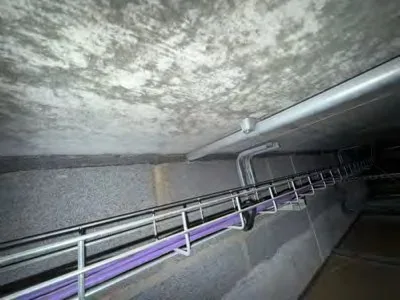
Barriers and fire stopping are not the same
They get mixed up, so it is worth being clear.
A cavity barrier stops fire travelling along a concealed space. Fire stopping seals a hole where something passes through a wall or floor.
Approved Document B, the guidance behind the Building Regulations, treats them separately. A building can have good fire stopping and still have no barriers in the roof void.
What we find
Roof voids where the compartment wall stops at the ceiling and the void carries on over the top of it.
Ceiling spaces where a barrier was cut for a cable and not put back.
Barriers that fell out because the fixings were wrong.
Barriers made of the wrong material, or a different size from the cavity they were supposed to fill.
What goes in
Mineral wool in a sleeve or a strip, compressed into the gap and fixed so it cannot slip.
Intumescent strips, for narrow cavities where wool will not fit.
Open-state barriers, where the cavity has to keep ventilation. They stay open in normal use and close when heated.
Which is right depends on the width of the cavity, whether it must ventilate and how long the barrier has to hold.
Access is half the job
Roof voids are low, dusty and have joists to crawl over. Ceiling spaces mean lifting tiles or cutting access hatches.
We say in the price how much we think we can reach without opening up. If a barrier is only found after the ceiling is open, you will hear about it before we go further.
External walls
Cavity barriers in an external wall system, such as cladding on a tall block, are a bigger piece of work with its own rules. Ask us first and we will say whether it is something we can take on.
Questions we get asked
How do I know if my roof void has barriers?
Someone has to go up and look. That is part of a compartmentation survey. See that page.
Can barriers be fitted without taking the ceiling down?
Sometimes. Where there is an existing access hatch or removable tiles, yes. Otherwise we open a hatch and close it again afterwards.
Send us the postcode and a photo or two. We will tell you what it needs and give you a price.
Get a price